After completing our first semester and wrapping up the exam season, we’re excited to settle back into our routines and continue developing our Fusor within Project Plasma! As we begin this year, we want to take a moment to reflect on the progress we’ve made so far and share some of our plans for the future.
This time last year, neither this project nor our team existed. To have made this much progress so quickly is something we’re both incredibly proud of and grateful for. This, of course, would not have been possible without the dedication of our team, and the guidance of our academic lead, who has helped drive this project forward from the very beginning. We would also like to take this opportunity to thank ANFS (University of Sheffield’s Nuclear & Fusion Society), who have been instrumental in promoting the project, and providing outreach and networking opportunities.
Alongside settling into roles, ranging from social secretaries to financial officers, we’ve been actively developing the core subsystems of the fusor. In the following sections, we summarise our progress, and discuss the next steps we’re taking to further develop our fusor.
Grids
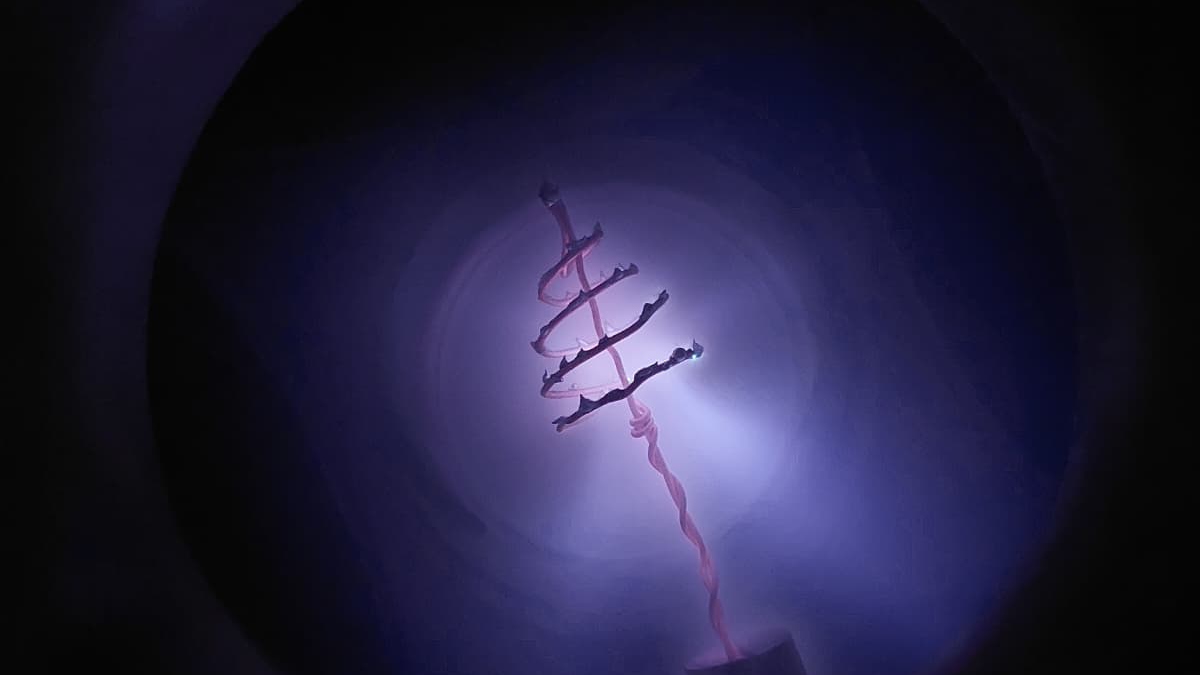
The inner grid is the core component of the fusor. It is designed with high transparency so that the majority of ions can pass through it and converge at the centre. At sufficiently high energy and density, these ions can undergo fusion, forming a plasma core.
This past semester, we have manually constructed prototype grids using copper wire to explore different geometries. We have found that spherical grids composed of concentric rings offered the most promising performance.
Next steps this semester involve computational modelling of the electric fields generated by different grid geometries, allowing us to optimise ion trajectories, improve confinement, and enhance plasma stability before manufacturing our next design iteration.
High Voltage Systems
Our initial setup operated with a 3 kV power supply and transformer running from a 12 V source. While this allowed us to begin plasma formation experiments, higher voltages are required to move closer to fusion-relevant conditions.
We have since upgraded to a 25 kV power supply with a ballast resistor for current limiting and system protection. We are currently experimenting with different ballast resistor configurations to optimise performance at lower operating voltages.
Alongside the main system, we are also developing a challenging and exciting addition to the project: a Pocket Fusor, a compact plasma demonstration device designed for educational outreach.
Vacuum & Pressure Systems
Achieving low pressure within the chamber is essential to sustaining plasma. Reduced pressure allows charged particles to accelerate in the electric field without excessive energy loss through gas collisions.
Recent work last semester involved installing a turbomolecular pump to significantly improve our achievable base pressure. This marks a major step forward in system capability.
Future work will focus on implementing a redesigned valve and tubing network to improve pumping efficiency, control, and operational reliability.
Gas Handling Systems
Our end-of-year goal is to reach neutron production using deuterium fuel.
To achieve this, we are developing a dedicated gas handling system consisting of a high-pressure D2 bottle, a mass flow controller, and a precision valve network to regulate flow rates down to approximately 1 SCCM.
Component orders are being finalised this month, making this one of the most exciting upcoming milestones for the team.
Imaging & Control Systems
Currently, a Raspberry Pi is used to capture plasma images and control the main valve within the vacuum system.
Looking ahead, we aim to integrate all subsystems, high voltage, vacuum, gas flow, and diagnostics, into a unified remote control architecture. Custom software running on the Pi will allow coordinated operation, improved safety, and real-time monitoring.
Overall, the progress we have made so far has been incredibly rewarding, and is a testament to the dedication of our passionate team. We look forward to further developing the fusor, and are excited to see where this journey takes us.