
Introduction
The mini fusor is a demonstrative IEC fusor intended to sustain a plasma flow in a vacuum using the same systems as its larger sister, just scaled down. Note: it is not intended to actually fuse material like our larger fusor, as doing so produces radiation and is not suitable for presentation. Instead, this is an interesting project in which I have reused spare components given to us by the studentship which led to Project Plasma’s founding, to experiment with this idea of miniaturisation of a plasma. My vision is a small, portable fusor chamber which is safe to handle and gives a bright glow in a lit room so that it can be taken to events and represent the physics underlying the project without requiring the prerequisite of a vacuum pump or high voltage power supply our current fusor requires. As such there are three key goals to this demonstrative mini fusor:
- Must be powered by a lab bench power supply - or ideally battery powered
- All high voltage must be contained inside a grounded chamber
- The chamber must hold a suitable pressure for plasma without a vacuum pump for sustained time
This blog post will go through the design and construction process of Project Plasma’s first mini fusor. Throughout I have tried to keep in line with these objectives set out, achieving them to limited success. I then reflect on how the mini fusor can be improved and what it would take to have an ideal system.
Design
For a demonstrative fusor, a ‘star in a jar’ design would be ideal, where the main body around the grid is glass, to give view of plasma at all angles, with two usable feedthroughs at each end of this tube. In order to keep costs within budget we are recycling parts however, after checking the inventory in our lab for vacuum chamber pieces without damage, we had all but one of the parts we would need. The mini fusor requires a gas feedthrough and a power feedthrough, as well as a window, as such a 40CF T-junction was chosen as the main chamber body where the grid would be held at the intersection. The chamber is pumped out using the hoseline from our two pumps in the lab, this runs through a valve attached to the mini fusor which can be shut so that the hose can be detached and prevent repressurising. There are differences between this sketch design and final build as I encountered practical difficulties with fitting the valve to the T-junction, and gave more space to fit in the circuitry. Unfortunately this adds significantly to the size of the mini fusor, but we are lucky to have had sufficient extensions lying around.
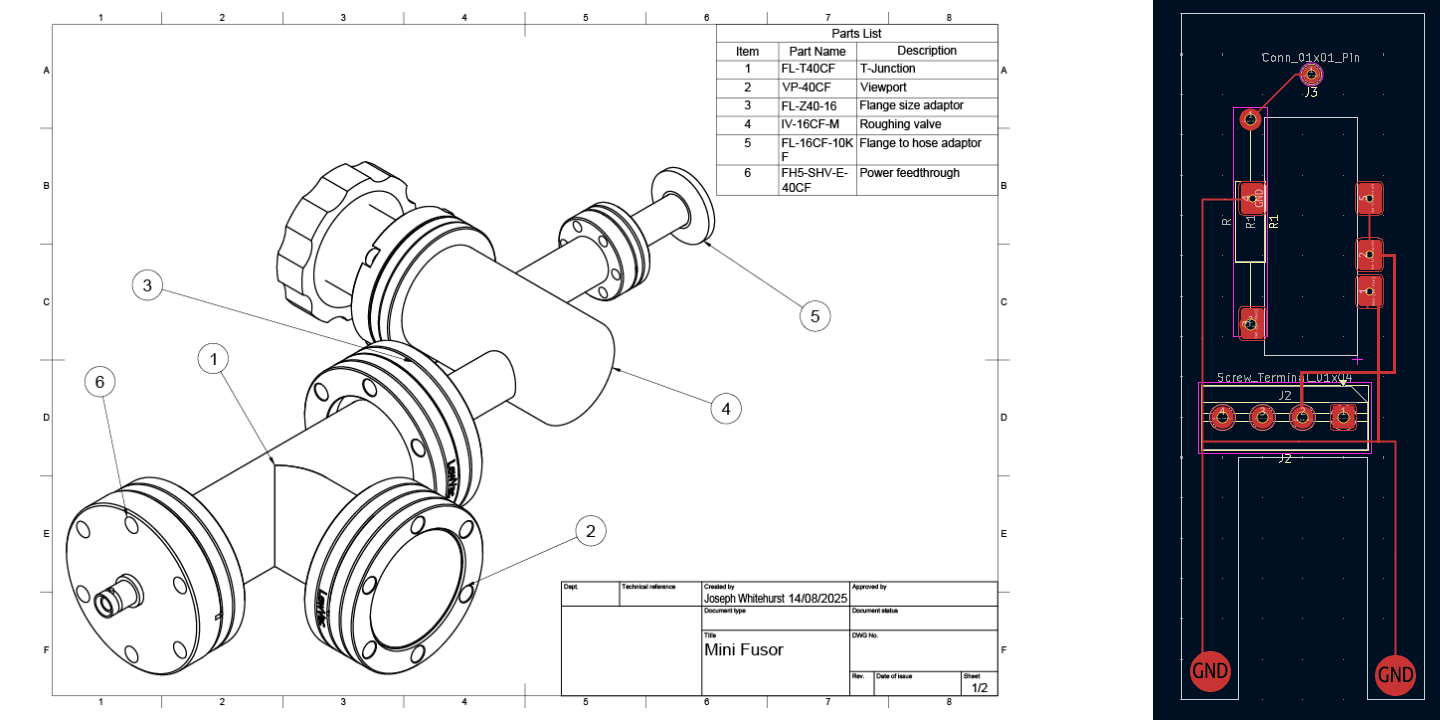 The original schematics for the fusor chamber and a diagram of the internal circuitry.
In order to function safely the internal circuit had to be kept isolated from the fusor chamber, which was grounded to Earth. Other than this constraint, the plan for powering the grid was fairly simple: apply a low voltage from a 12V supply into the SHV feedthrough, leading to the positive terminal of a transformer on the inside which would ramp voltage up to ~3000V. A floating PCB circuit hosts this, attached to the feedthrough prong so that the high voltage line is contained and isolated inside the chamber, which is grounded via the power supply. A resistor is essential to generating a stable and bright plasma, and is placed before the high voltage current reaches the grid. Our grid has a long stalk, this is to reduce the plasma being decentralised from the spherical area due to the close proximity of the conductive copper PCB. In order to complete the circuit, curled springy copper pads would firmly press against the wall of the high voltage fitting, conducting the negative terminal of the transformer to ground while also supporting the PCB so it doesn’t slip out of place.
Paschen’s law relates the breakdown distance (the minimum separation) charge can jump (arc) between electrical components at a given potential difference and pressure. This was used a lot. An extension piece was used for extra breathing room to host the circuitry, by this point I understood that the mini fusor was larger than already expected and was not likely to hold a vacuum for long periods of time, so I was happy to add a few inches in the name of safety. This circuitry can be packed into a smaller space in a more three dimensional arrangement, or using insulation between wires.
Construction
This is the fun part! This vacuum chamber was made using conflat (CF) flange fittings, these are stainless steel pieces which are held together by nuts and bolts. Between each part of the vacuum chamber a copper gasket is placed very carefully so as to line up properly and be squeezed in and hold the vacuum seal to prevent leaks. This leaves an imprint on each gasket after use, making them single use if you want a perfect seal, this is inconvenient for swapping out and testing resistors or grids on the inside of the chamber. While tinkering with the circuit, one gasket was repeatedly reused with the pump applied to counter leaking.
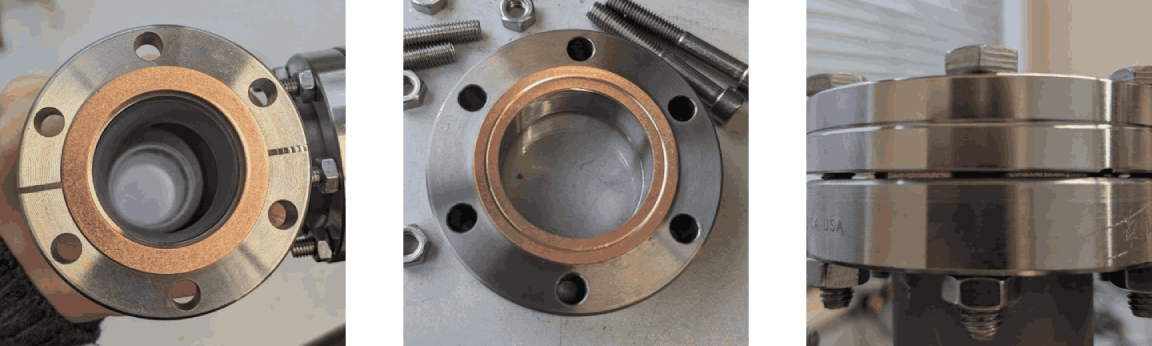 Fresh and imprinted gaskets, the picture on the right shows a gasket between two flanges before tightening. A sealed joint should not have the copper gasket visible.
Once I was happy I replaced it with a fresh one and haven’t opened the mini fusor since. To properly attach CF pieces together and prevent the gasket from slipping or being squeezed on unevenly the bolts are tightened in a cross-pattern. As an addition, I later designed and 3D printed an eyepiece to be attached to the window of the mini fusor, to prevent glare on the glass obscuring results.
I used KiCad to create schematics for the circuit and mill it out accordingly, giving 2mm between wires. The transformer was soldered on, along with the resistor and grid being used, and the circuit’s continuity was thoroughly checked with an ammeter. A screw terminal block was positioned with a terminal central to the PCB, this attached to the single feedthrough prong and had to be aligned so that the circuit fit inside the fusor. The copper pads were sweat soldered on and bent round in order to push into the fusor chamber, establishing the grounding line, this also adds structural support so that the electronics don’t wobble and misalign, risking arcing out to the chamber. The inner grid was made using thinner wire and smaller diameter in order to be proportional with the smaller chamber of the mini fusor. High voltage arcing makes this seem scary, but there is sufficient spacing between wires on the circuit as a precaution, if it were seriously misaligned and touched the sides, the high voltage line in the circuit was still isolated.
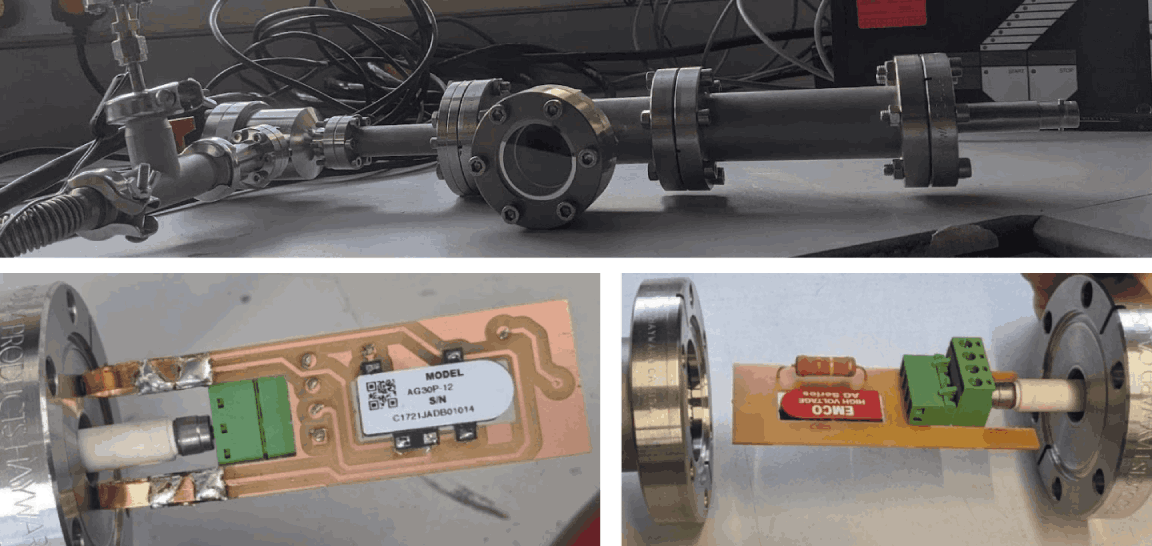 The final product, the mini fusor in full with hose and pressure gauge attached. Below are images of the circuit at different stages, the grid stalk is soldered into the pinhole at the end.
Testing
Before ever turning on the power supply the chamber was pumped down, only a few leaks were found and were corrected by tightening pieces together. While the chamber emptied swiftly and bottomed out readings on our pressure gauge, after closing the chamber off with a roughing valve the pressure rose again too quickly. Even after refitting the power input with a fresh gasket and tightening everything this remained an issue, no plasma could be held for more than about 3 minutes. I have tried to diagnose the cause of this and came to the conclusion that the roughing valve is the issue, either not being tightened enough or fit properly, but as one of the most expensive parts of the assembly I turned to solving other challenges first.
Wanting to get a bright plasma flow that can be visible in a lit room I experimented with three different values of resistance, settling on 340kΩ. Another other factor which changes how bright the plasma will be is pressure, which can be controlled manually by the roughing valve. But unfortunately as pressure is decreased the transformer will overheat as it can not lose energy by convection cooling. As such the mini fusor is not operated at pressures below 100mb for longer than 8 minutes, as this will kill the transformer. Again, this is clearly a limitation to the mini fusor, but it limits demonstrative time less than the pressure leaking, as above a pressure of about 300mb our plasma begins to dissipate altogether. The best plasmas formed in the lab were visible with the lights on to about half a foot away, the longest test sustaining good visibility lasted 2 minutes 46 seconds, this is long enough for a few people to observe but not indefinite. And the plasma could always be brighter, testing different grid sizes and proportions to the chamber is underway to do this.
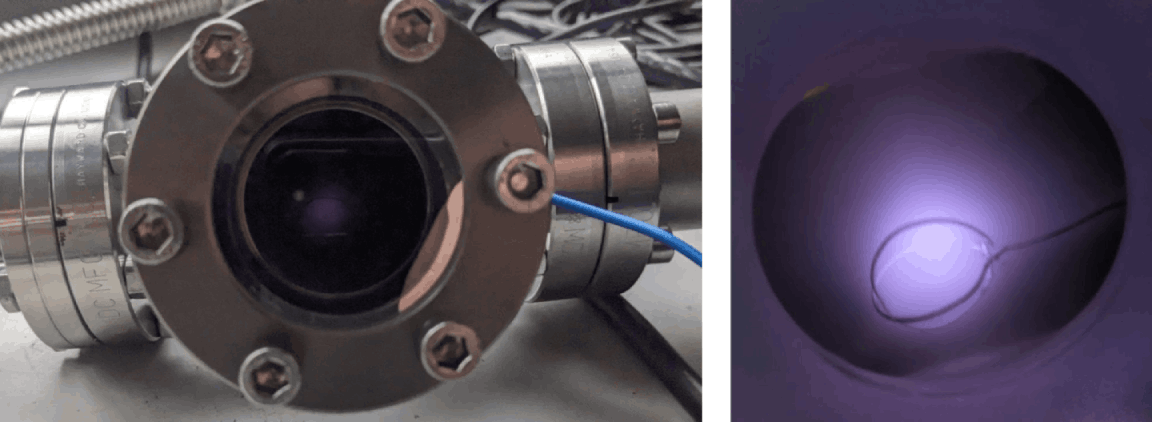 A close up of the plasma glow, and an image a few inches away for reference as to how bright this is in our lab.
What’s next
Currently we have the capability to run demonstrations relatively easily outside of our lab, so long as there is a power supply and, less commonly, a vacuum pump available. Within Universities this equipment is common and is not a problem, instead the permission to run the experiment would be the cause for any struggle. As such any improvements made from this original design need to have safety in mind while being portable. It must be made childproof if a mini fusor could be presented at open days for UoS or taken offsite.
For practicality, and to run prolonged demonstrations I would redesign a mini fusor to have the high voltage outside of the depressurised chamber. This should also then be contained, ideally sealed, to avoid contact with handlers. This is challenging as the high voltage needs to convect heat in an enclosed area while also having reliable insulation to prevent arcing. In terms of insulation, for 4000V in air at one atmosphere breakdown distance is up to 4mm, which is thankfully a scale small enough to work with if the circuit was suspended. A suspended circuit will need to be secured more firmly than currently too, as any dislodgment can cause arcing. Using insulation in the inside of this chamber is a good option being researched currently. Liquid epoxy, like potting compounds, exist which insulate against electrical current but conduct heat, if the circuit was embedded in this then it would be entirely safe and clearly visible, adding to how we can explain the process of supplying a high voltage to a grid. 9V batteries could be used to power the device.
More tests will be run on the current mini fusor to try and diagnose the cause for leaks and fix this issue. Given the transformer won’t be exposed to low pressures, there is no concern about going too far, or reading the pressure inside the chamber, plasma glow is the objective here and can continue to much lower pressures. A smaller and different style of valve could be used after evacuating the chamber. If the leak rate is still too high, and a plasma can’t be held for more than a day for an event then I have discussed welding the chamber together with the University. If the third key objective can’t be fulfilled and a pump is necessary in the meantime, we will replace the current bulky metal hose for a long, flexible rubber pipe so that a mini fusor can be held and moved easily.
As mentioned earlier a second mini fusor would follow a design closer to a ‘star in a jar’ where power is fed in on one end and gas evacuated out of the other. Our associated academic bought a sight glass used in brewing and attempted to fashion a fusor from it. It is unfortunately very leaky and cannot reach a low enough pressure to form a plasma around the grid, but this will be fixed and there is no reason as to why we cannot adapt the design to meet the three key objectives which would make it ideal for demonstrations, should we have the materials needed. For now we will make this as airtight as possible and better understand shielding and grounding to operate a high voltage using a battery safely.
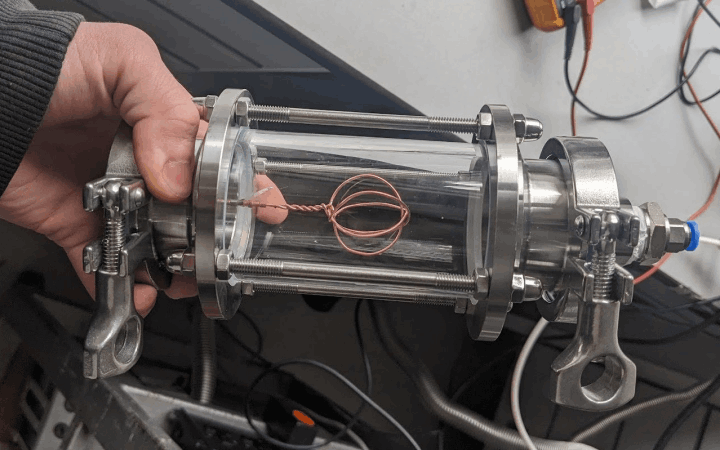 Our newest mini fusor we are working on right now, this is the type of design we would aim to make work as it is clearly more presentable.
To conclude, this first mini fusor achieves a stable plasma which is visible in a lit room up close. Both mini fusors can be used to test combinations of grids, pressures and resistances to maximize plasma glow at this scale. I have found the limitations to achieving a safe and fully portable fusor capable of demonstrating the physics occurring in an IEC fusor to audiences. These limitations can and will be overcome given the right resources, and an appropriate device can be used in outreach to inspire people and show what Project Plasma is involved in.